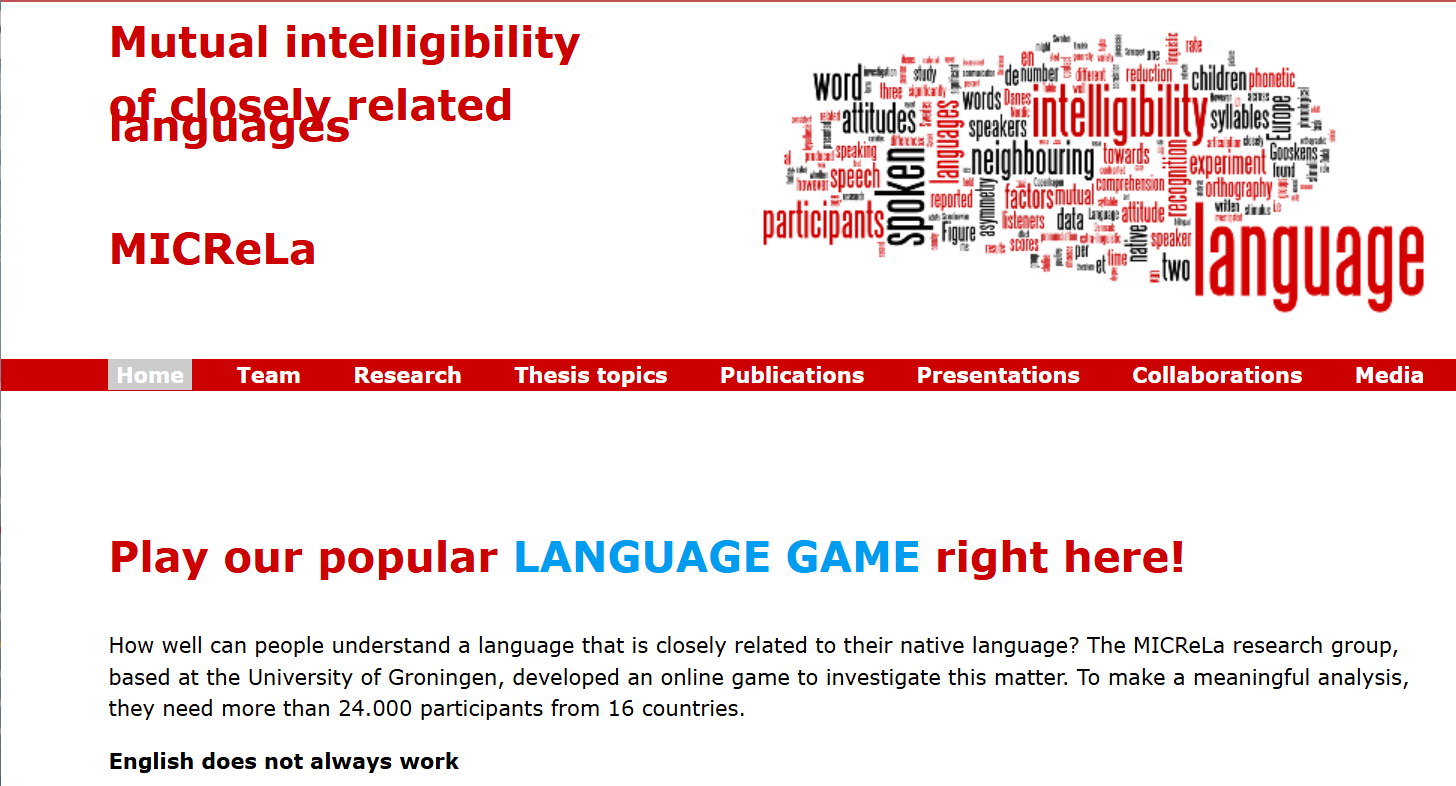
“Mutual Intelligibility of Closely Related Languages” is a large-scale European research project based at the University of Groningen. It investigates receptive multilingualism—the ability of speakers of closely related languages to understand each other using their respective native tongues without relying on English as a lingua franca.
By combining phonetic and lexical distance measurements with an online, gamified testing platform (The Language Game), MICReLa collects empirical data across 16 European languages in the Germanic, Slavic, and Romance families to model the determinants of interlingual comprehension.
Country: The Netherlands
Languages: bg, cs, da, de, en, es, fr, hr, it, nl, pl, pt, ro, sk, sl, sv
Participation: open to participate
Focus: IC ability testing
Scope: research project
State: discontinued
The project applies the Seven Sieves (Sieben Siebe) method, a framework designed to enable learners to deduce the meaning of written texts by identifying lexical patterns, shared affixes, syntactic structures, and sound correspondences across related languages—without the need to study each individual grammar from scratch.