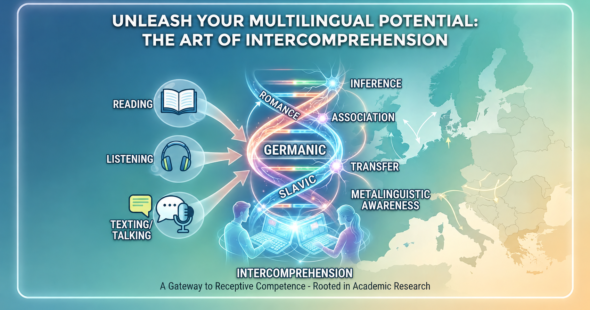
Plurimente is a private school of Romance Intercomprehension based in Spain. It offers offline and online groups lessons of Romance Intercomprehension with the EuRom5 method comprising the following languages: Italian, Portuguese, French and Catalan with the Spanish being the base language.Plurimente offers an opportunity to know intercomprehension to anyone interested in the method regardless of their affiliation to any educational institution. The courses are centered in developing cognitive strategies such as the inference for language learning.
go to website
Countries:
Spain
Languages:
es, fr, it, lat, pt
Participation rules:
open to participate
Focus:
cognitive strategies
Type:
IC practical course
Status:
operating
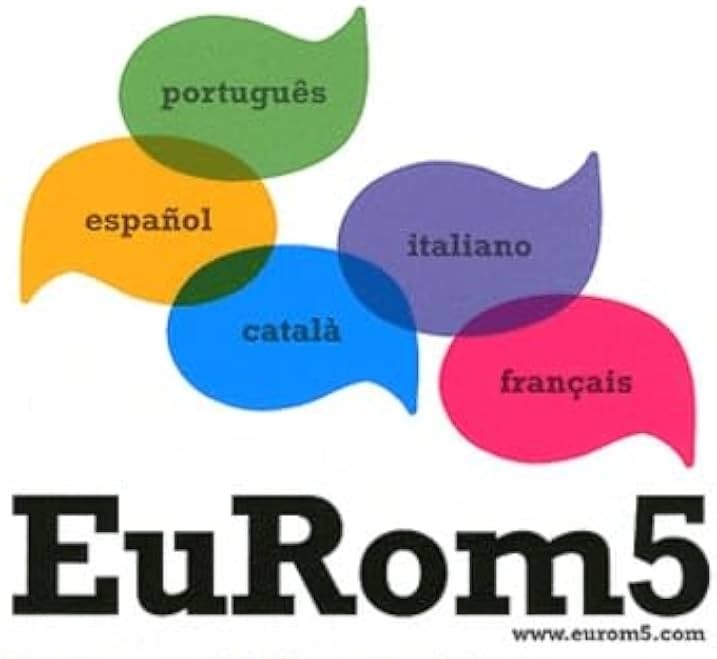
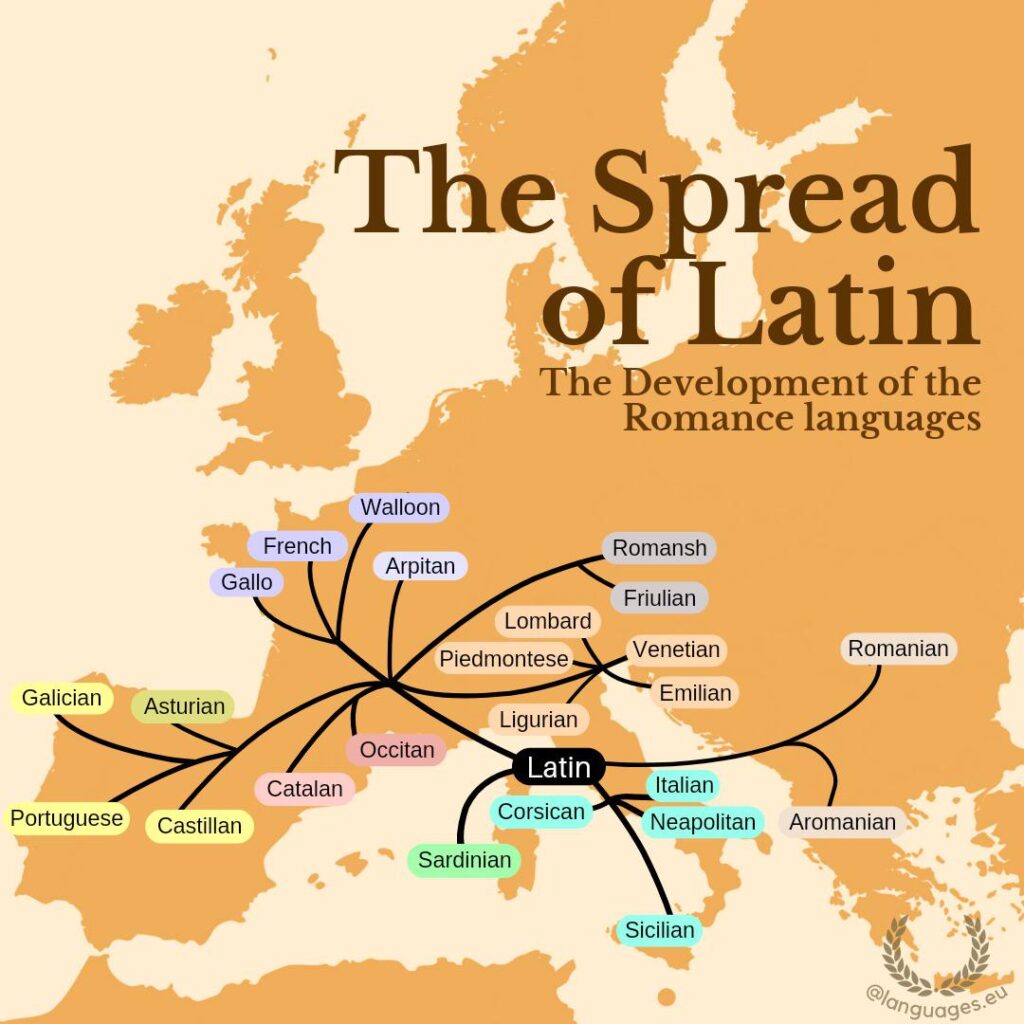
EuRom5 is a method that leverages the linguistic closeness of the Romance language family (Spanish, Italian, French, Portuguese, and Catalan) to develop simultaneous reading comprehension across these five languages.Instead of memorizing traditional grammar, the methodology focuses on pattern recognition, lexical transparency, and cognitive strategies. This makes it possible to learn to read and understand real texts in multiple languages from the very first sessions, achieving rapid, practical, and fluent receptive mastery. The research is originated in France, but is currently developed in Rome, Italy. The product of the research is a handbook EuRom5 with access to an online platform with audio recordings. This book can be used by any learner / tutor independently.
go to website
Countries:
Italy
Languages:
es, fr, it, pt
Participation rules:
insiders only
Focus:
cognitive strategies, linguistic awareness
Type:
IC practical course, research project
Status:
operating
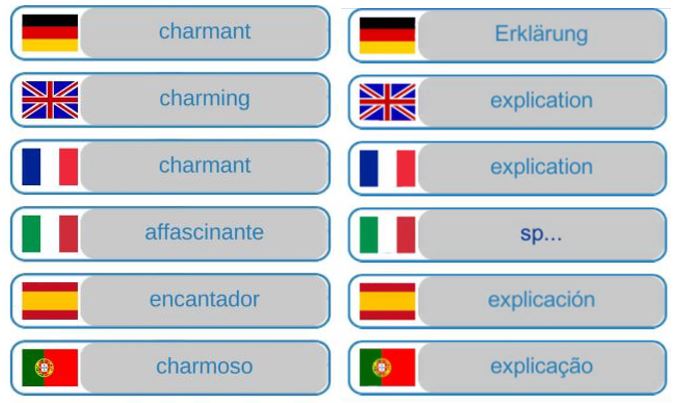
EuroComDidact is a methodological project and a pioneering educational initiative in the field of intercomprehension among Romance languages. Developed in German academia by linguists and Romance scholars Horst G. Klein and Franz-Joseph Meißner, the project translates theoretical research into practical multilingual education.The project applies the Seven Sieves (Sieben Siebe) method, a framework designed to enable learners to deduce the meaning of written texts by identifying lexical patterns, shared affixes, syntactic structures, and sound correspondences across related languages—without the need to study each individual grammar from scratch. As a result of the research, an app was developed which currently is not accessible though.
go to website
Countries:
Germany
Languages:
de, en, es, fr, it, pt
Participation rules:
open to participate
Focus:
language acquisition
Type:
Erasmus preparation, generic, research project
Status:
discontinued
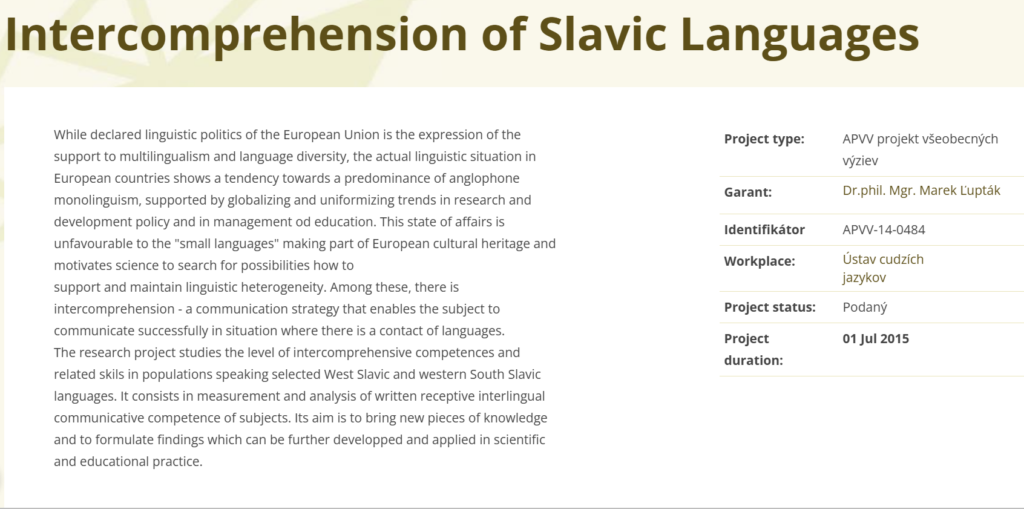
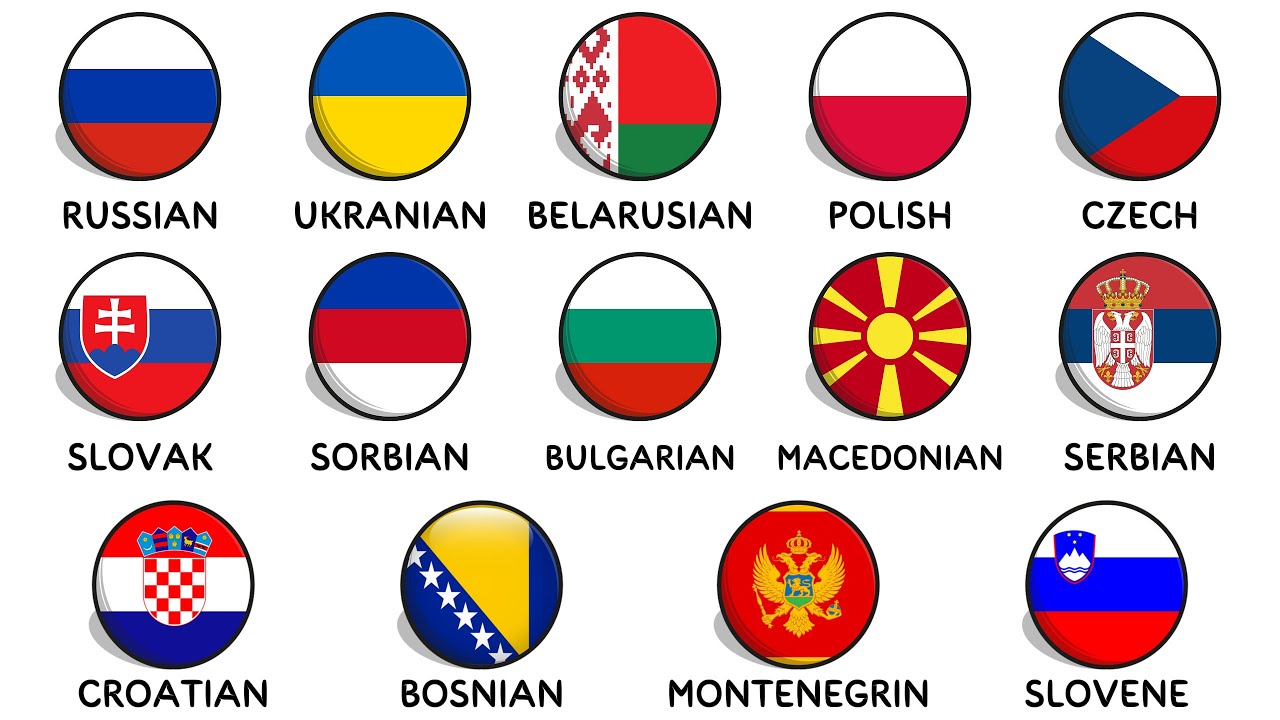
Intercomprehension of Slavic Languages (APVV-14-0484) is an academic research project led by the Technical University in Zvolen (Slovakia). The project evaluates written receptive communicative competence across West Slavic (e.g., Slovak, Czech, Polish) and Western South Slavic languages (e.g., Slovene, Croatian).By empirically measuring how speakers decode written texts in related Slavic languages without prior instruction, the research aims to support receptive multilingualism as a viable strategy for preserving European linguistic diversity. The project contributed data on how receptive skills in related languages can be leveraged in technical and university settings to bypass formal L2 instruction for reading technical documentation.
go to website
Countries:
Slovakia
Languages:
cz, pl, sl
Participation rules:
insiders only
Focus:
IC ability testing
Type:
research project
Status:
discontinued
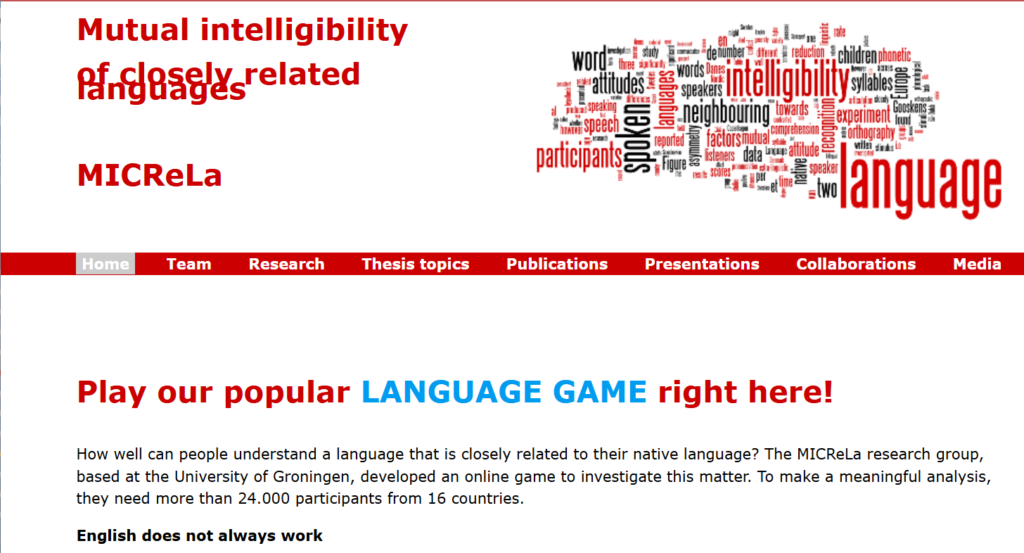
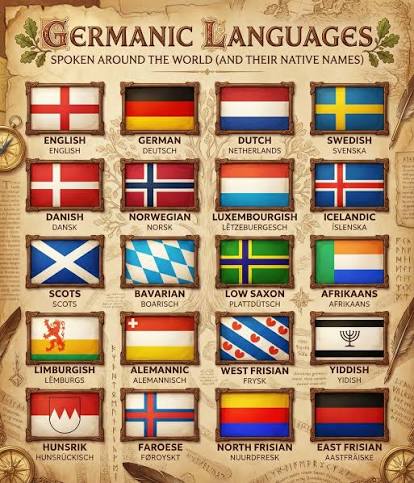
"Mutual Intelligibility of Closely Related Languages" is a large-scale European research project based at the University of Groningen. It investigates receptive multilingualism—the ability of speakers of closely related languages to understand each other using their respective native tongues without relying on English as a lingua franca.By combining phonetic and lexical distance measurements with an online, gamified testing platform (The Language Game), MICReLa collects empirical data across 16 European languages in the Germanic, Slavic, and Romance families to model the determinants of interlingual comprehension. The project applies the Seven Sieves (Sieben Siebe) method, a framework designed to enable learners to deduce the meaning of written texts by identifying lexical patterns, shared affixes, syntactic structures, and sound correspondences across related languages—without the need to study each individual grammar from scratch.
go to website
Countries:
The Netherlands
Languages:
bg, cs, da, de, en, es, fr, hr, it, nl, pl, pt, ro, sk, sl, sv
Participation rules:
open to participate
Focus:
IC ability testing
Type:
research project
Status:
discontinued
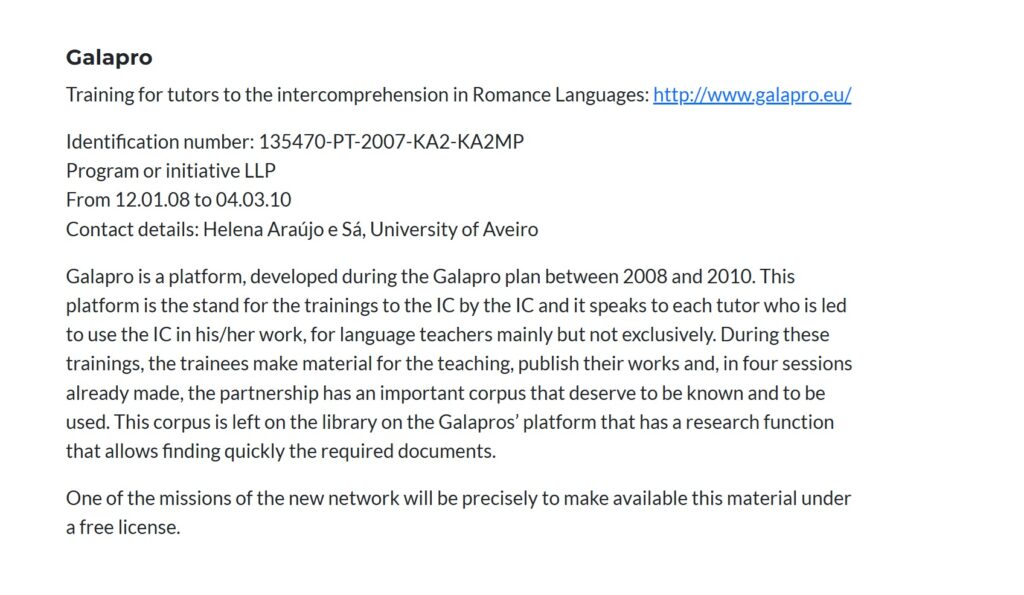
Galapro (2008–2010): A European tutor-training platform developed under the LLP program (coordinated by Helena Araújo e Sá at the University of Aveiro) focused on training educators to teach and use intercomprehension. It generated an extensive corpus of open-access teaching materials and operated within restricted academic and institutional frameworks rather than being open to the general public.
go to website
Languages:
es, fr, it, pt, ro
Participation rules:
insiders only
Focus:
linguistic awareness
Type:
research project
Status:
discontinued
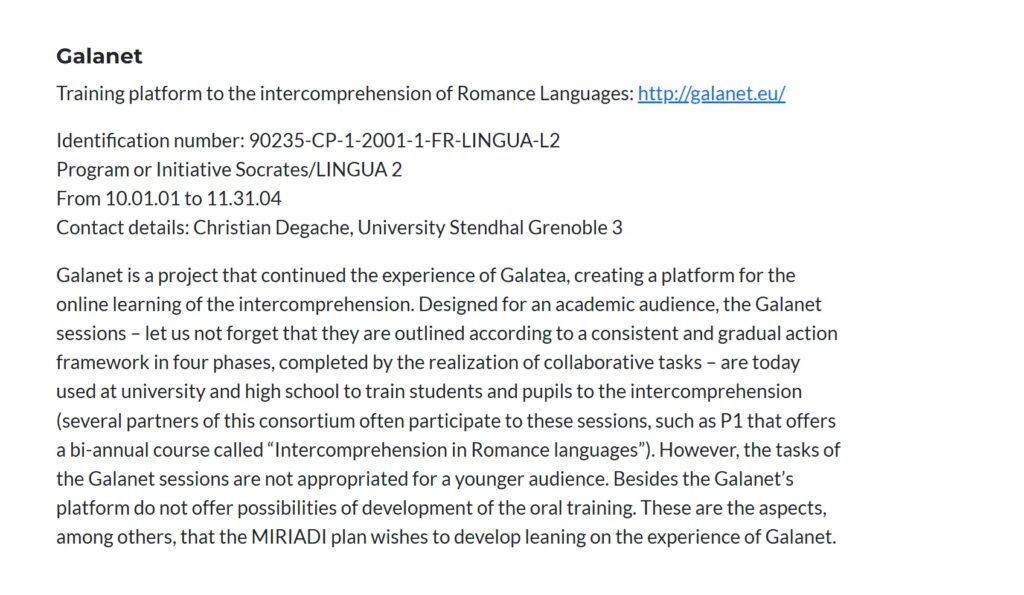
Galanet (2001–2004): A pioneering European online training platform coordinated by University Stendhal Grenoble 3 under Socrates/LINGUA 2, designed to foster academic intercomprehension through a structured four-phase collaborative framework. While its original platform is no longer active, its methodology laid foundational groundwork for digital multilingual learning.
go to website
Countries:
France, Italy, Portugal, Romania, Spain
Languages:
es, fr, it, pt, ro
Participation rules:
insiders only
Focus:
linguistic awareness
Type:
generic, research project
Status:
discontinued
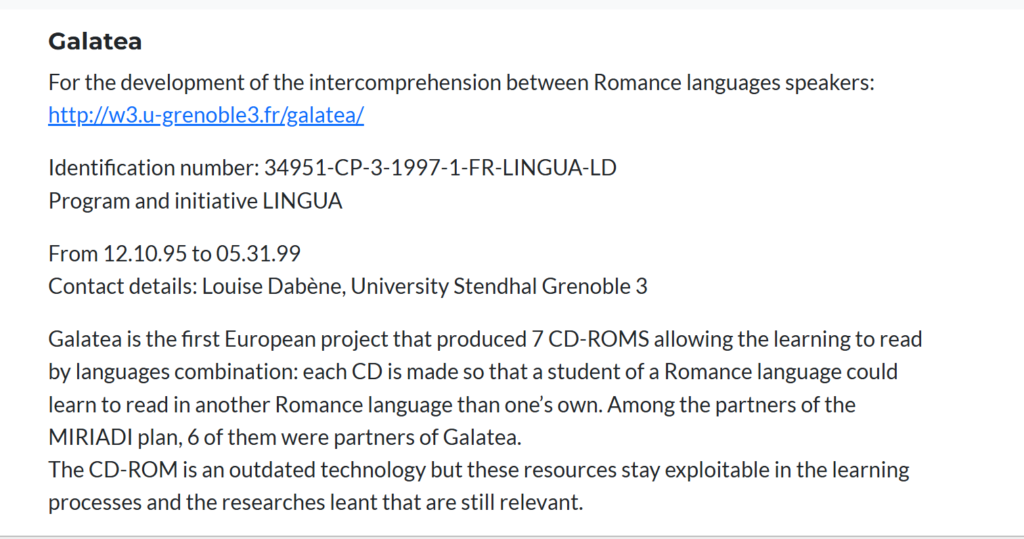
EuroComDidact Galatea is a European project developed between December 1995 and May 1999 under the LINGUA initiative (identification number: 34951-CP-3-1997-1-FR-LINGUA-LD), coordinated by Louise Dabène at the University Stendhal Grenoble 3.Key details of the project include:Objective: It was the first European project created to develop reading intercomprehension among speakers of Romance languages.Methodology: It produced 7 CD-ROMs designed so that a student of one Romance language could learn to read in other Romance languages without starting from scratch. Legacy: Although the CD-ROM technology is outdated, its resources remain exploitable for learning processes, and foundational research from the project continues to be relevant. Six of its original partners later became part of the Miriadi network.
go to website
Countries:
France
Languages:
es, fr, it, pt
Participation rules:
open to participate
Focus:
linguistic awareness
Type:
generic, research project
Status:
discontinued