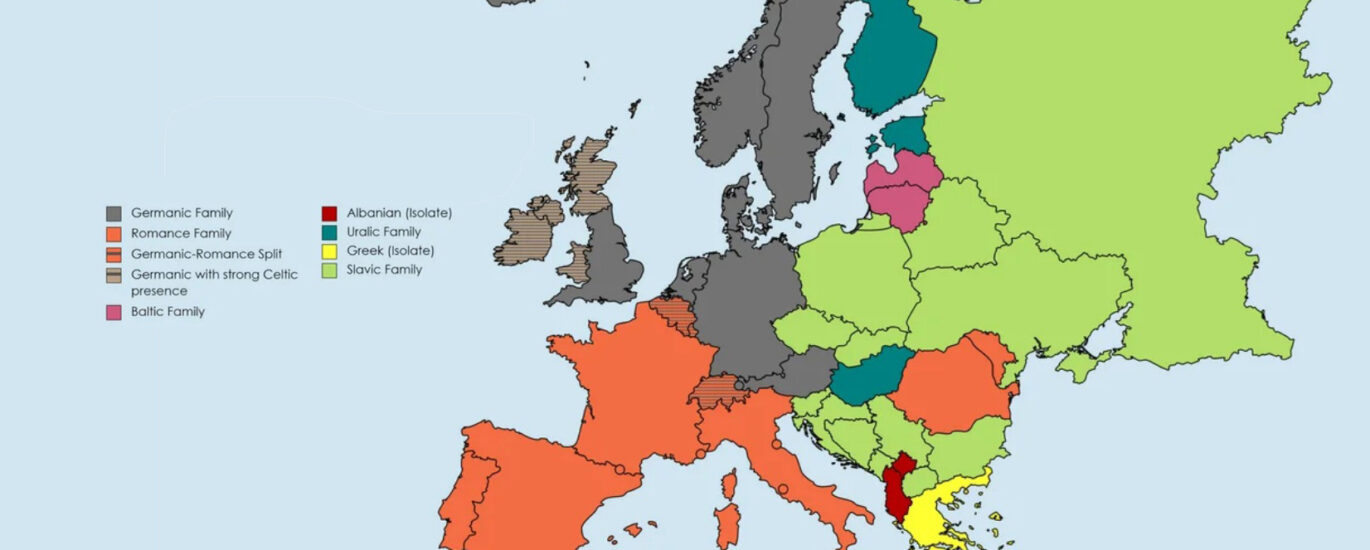
Imagine stepping out your door in Portugal, starting a walk toward the vast stretches of Russia, and gently tweaking your speech kilometer by kilometer. While it is a poetic metaphor rather than a literal map, Europe’s linguistic landscape genuinely behaves like an interconnected mosaic. Thanks to the magic of intercomprehension—the ability to understand a related language without formally studying it—we can see how Europe’s major speech families form deep, overlapping tapestries.
At a high level, Europe is shaped by three massive linguistic groups: Romance, Germanic, and Slavic. Let’s take a journey through these families to see how many varieties live inside each, and how unique “bridge languages” help connect them all from an intercomprehension perspective.
1. The Romance Family: From Vulgar Latin to a Mediterranean Mosaic
Born from the evolution of spoken Latin, the Romance continuum stretches smoothly across southern and western Europe. While official state borders draw hard lines around standard languages, the ground level is a fluid spectrum of dialects and regional forms.
- The Numbers: While there are roughly 10 to 12 major standardized Romance languages with official recognition, a look at the broader geographic continuum reveals over 30 significant Romance varieties (including regional vernaculars and historical tongues).
- Main Branches:
- Ibero-Romance (Spanish, Portuguese, Galician, Catalan, Asturleonese, Aragonese).
- Galo-Romance (French, Occitan, Franco-Provençal, and northern d’oïl varieties).
- Italo-Romance (Italian standard, northern Gallo-Italic varieties, southern dialects, and Sardo).
- Rhaeto-Romance (Romansh, Ladin, Friulian).
- Balkan-Romance (Romanian, Aromanian, and related eastern forms).
2. The Germanic Family: From Northern Fjords to Central Plains
Moving north and central, we enter the Germanic realm. Like their southern neighbors, Germanic languages share deep historical roots and feature smooth transitional zones—especially across continental Europe where local speech shifts gradually without abrupt boundaries.
- The Numbers: Around 10 to 12 primary standardized varieties dominate institutional life, but accounting for traditional regional dialects and local idioms brings the total to over 30 distinct Germanic varieties.
- Main Branches:
- North Germanic (Scandinavian): Norwegian (with its dual written standards), Danish, Swedish, Icelandic, and Faroese.
- West Germanic: English, German, Dutch/Flemish, Frisian, Luxembourgish, and Yiddish (alongside heavyweights like Low German/Plattdeutsch).
- East Germanic: Fully extinct today, housing historical tongues like Gothic.
3. The Slavic Family: Pillars, States, and Structured Borders
As we move eastward, the linguistic landscape shifts its texture. Unlike the fluid, continuous transitions of Western Europe, the Slavic world is marked by sharper historical, political, and religious borders that carved out distinct national standards—often reinforced by different alphabets (Cyrillic in the east and south, Latin in the west).
- The Numbers: The Slavic family is more compactly structured, featuring roughly 12+ recognized standard languages divided into three clean geographic blocks.
- Main Branches:
- East Slavic: Russian, Ukrainian, and Belarusian.
- West Slavic: Polish, Czech, Slovak, and Sorbian (spoken in eastern Germany).
- South Slavic: Slovenian, the central South Slavic diasistema (Serbian, Croatian, Bosnian, and Montenegrin), Macedonian, and Bulgarian.
Connecting the Worlds: Bridge Languages Through Intercomprehension
When looking at the linguistic landscape through the lens of intercomprehension rather than traditional second-language acquisition, “bridge languages” take on a fascinating role. They function as natural connectors because their own intrinsic, hybrid characteristics make them comprehensible to a certain degree outside of their strict family bounds:
- English: Fundamentally a Germanic language, but heavily coated in a vast layer of Romance vocabulary due to historical influences. This hybrid DNA gives speakers from other families unexpected footholds.
- French: Inherently a Romance language, yet shaped by historical developments that left it with structural tendencies and syntax patterns closer to Germanic frameworks.
Because of this structural “weirdness,” these bridge languages act as natural cross-family stepping stones, offering a gateway for minds navigating the broader European continuum.
Why Intercomprehension Matters
Understanding how these families are structured changes the way we look at Europe. You don’t need to start from scratch to learn a neighboring tongue; by recognizing shared roots across the Romance, Germanic, or Slavic continuums, your brain can tap into natural linguistic instincts.
