

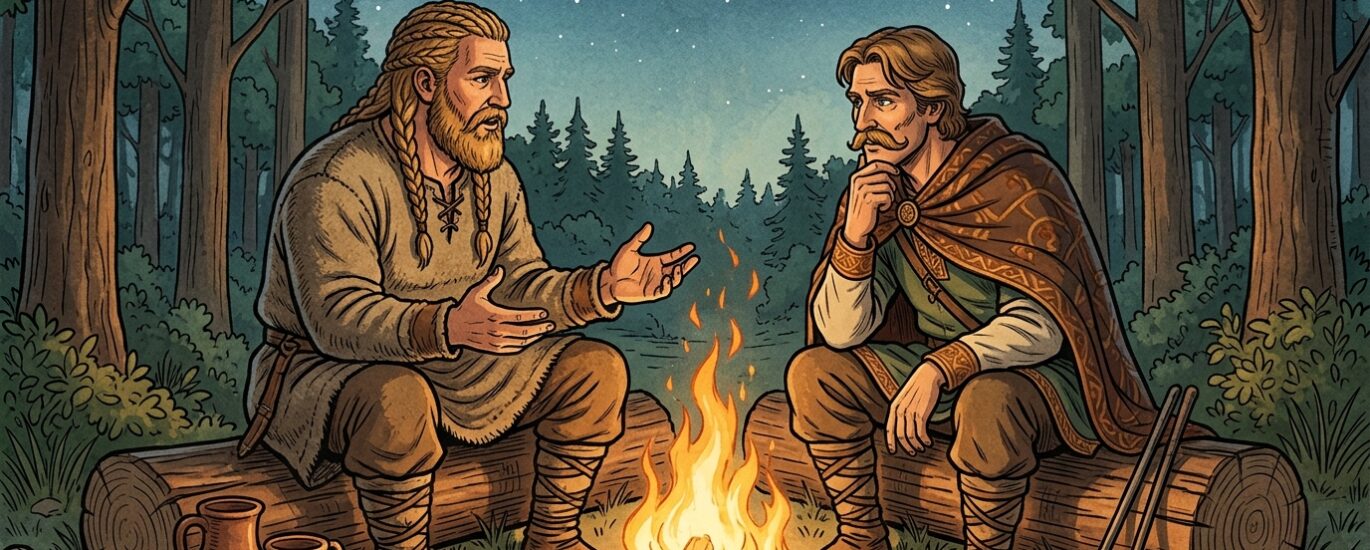
Long before modern academia began cataloging the cognitive processing models of multilingualism, a practical human experiment was quietly unfolding across the trading ports, imperial borders, and mountain passes of old Europe. People were conversing without a single shared language. Each person used their own native tongue, and while they routinely missed specific words or struggled with unfamiliar dialects, they understood enough of the core meaning to trade, travel, and coexist.
In today’s language industry, this organic communicative blueprint goes by several names: intercomprehension, mutual intelligibility, receptive multilingualism, and cross-understanding. Far from being a modern educational invention, it was simply the historical default setting of the European continent—a fluid negotiation where speakers relied on their ears to tolerate ambiguity and find common ground.
1. The Romance Continuum: The Legacy of the Street Latins
To see how this works naturally, we have to look back at the twilight of the Roman Empire. We often imagine ancient Romans speaking the pristine, rigid literary Latin found in classical texts. In reality, the common soldiers marching along the borders and the merchants haggling in Mediterranean ports spoke Sermo Vulgaris—Vulgar Latin.

When Rome’s central administrative power collapsed, these distant communities became politically isolated. Over generations, their spoken Latin slowly mutated, shifting vowels and eroding noun cases to adapt to local accents. This marked the birth of the earliest Vulgars, the direct precursors to modern Spanish, French, Italian, Portuguese, and Catalan.
For centuries during the early Middle Ages, there was no hard border between these emerging languages. A traveler riding from northern Italy into southern France encountered a slow, shifting gradient of speech. They didn’t view the neighboring dialect as an opaque, terrifying foreign tongue; it was simply a slightly altered version of their own speech. Intercomprehension was the everyday glue holding post-Latin European commerce together.
We even see this dynamic alive and well during the Age of Discovery. Historical records show that Christopher Columbus spoke and wrote in a fluid, deeply intercomprehensive mix of Genoese Italian, Spanish, and Portuguese. He did not switch neatly between isolated language boxes. His brain treated the entire Romance family as a single network, adjusting his receptive sails depending on who was listening.
2. The Germanic Story: Code-Shifts and the Hour-Long Fire
While the Romance family’s story is a continuous, fluid derivation of a single mother tongue, the story of the Germanic family is a tale of migrations and systematic code-shifts. Two thousand years ago, tribes across Northern Europe communicated with total mutual understanding in a shared ancestral language known as Proto-Germanic. However, as different groups scattered across the map, geographical distance forced their accents apart.
When the Angles and Saxons sailed across the North Sea to settle Britain in the 5th century, their language (Old English) began its own insular trajectory. Meanwhile, the tribes remaining on the continental mainland—specifically those in the mountainous south—underwent a phonological revolution known to linguists as the High German Consonant Shift.
Because of this massive shift, hard consonants mutated across entire vocabularies in predictable patterns. Where the English traveler said ship, open, and eat, the German speaker said schiff, offen, and essen.
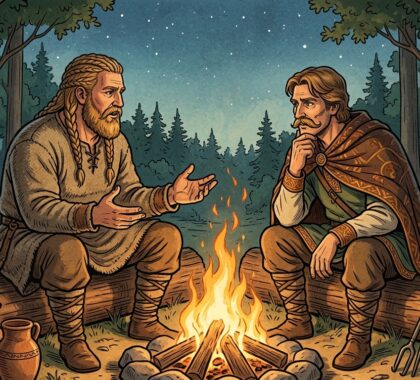
If a 6th-century Anglo-Saxon traveler encountered a continental German speaker, they wouldn’t have heard a totally alien tongue. Their underlying grammars, three genders, and complex case endings were still identical. They simply heard a thick, systematic accent. By sitting together around a fire for just a short time and noticing the pattern of the changing consonants, the traveler’s brain could adapt and decode the meaning. Today, this natural bridge remains highly functional across Scandinavia, where Danes, Swedes, and Norwegians easily read and understand each other’s native languages as a baseline cultural norm.
3. The Slavic Family: Real-World Testing on the Ground
The Slavic language family offers perhaps the most striking historical puzzle of all. During the migration period of the 6th to 9th centuries, Slavic tribes expanded with incredible speed across an immense geographic expanse—stretching from the Baltic Sea down to the Balkans. Remarkably, these widely scattered Slavic communities preserved their shared morphosyntactic and lexical core with an astonishing, iron-clad conservatism. For centuries after their geographic split, their mutual intelligibility remained nearly perfect.
But this is not just ancient history; it is a vital modern reality. Today, if you visit the border region between Germany, Poland, and Czechia, you will find a minority group called the Sorbians, who speak a small Western Slavic language called Upper Sorbian.
Field studies conducted in local bilingual high schools show that German-speaking teenagers who learn Sorbian experience a massive cognitive shortcut: they can suddenly read and understand Czech and Slovak texts on their travels.
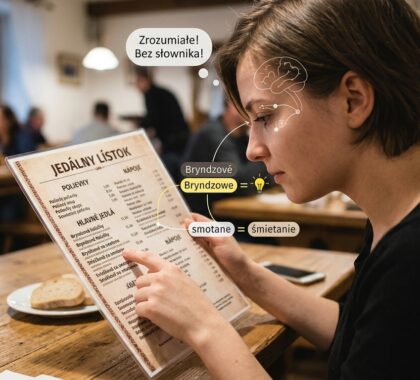
Because the languages share a dense structural and morphological footprint, the students use their knowledge of a minority tongue as a natural bridge to unlock a wider Slavic world. Even in daily life, a Slovak person reading a Czech news website or a Pole scanning a Slovak restaurant menu does not need a dictionary.
The brain instantly recognizes the overlapping morphology, matches the prefixes, and fills in the blanks, seamlessly tolerating the unfamiliar spelling.
View source
Dołowy-Rybińska, N. (2021). Interkomprehensja języków słowiańskich jako czynnik motywujący do uczenia się języka górnołużyckiego [Intercomprehension of Slavic languages as a motivating factor to learn Upper Sorbian]. Zeszyty Łużyckie, 55, 299–318.
4. The Cross-Family Frontier: The Role of Bridge Languages
As a compelling curiosity apart, our brains do not work in a vacuum when we encounter an unfamiliar text. The mind dynamically scans every single word we have ever learned, sometimes pulling shortcuts from entirely different language trees.
For instance, because English possesses a Germanic structural syntax but took more than half of its vocabulary from French and Latin, it frequently functions as an unintended “inter-family trampoline.” An educated European who speaks English as a second language can look at an unstudied Romance sentence and use those Latinate threads inside English as cognitive handrails to guess the meaning. Similarly, researchers exploring the deep divide between the Germanic and Slavic trees have demonstrated how a baseline command of a robust language like Russian can be used as a controlled mental buffer, helping a reader filter out script barriers and predict morphosyntactic shifts across the pan-Slavic continuum.
The ultimate lesson of linguistic history is clear: our minds are not designed to store languages in isolated, painful compartments. By understanding the historical pathways and structural patterns of Europe’s linguistic trees, we can transform the ancient curse of Babel into an interconnected, plurilingual playground.
