

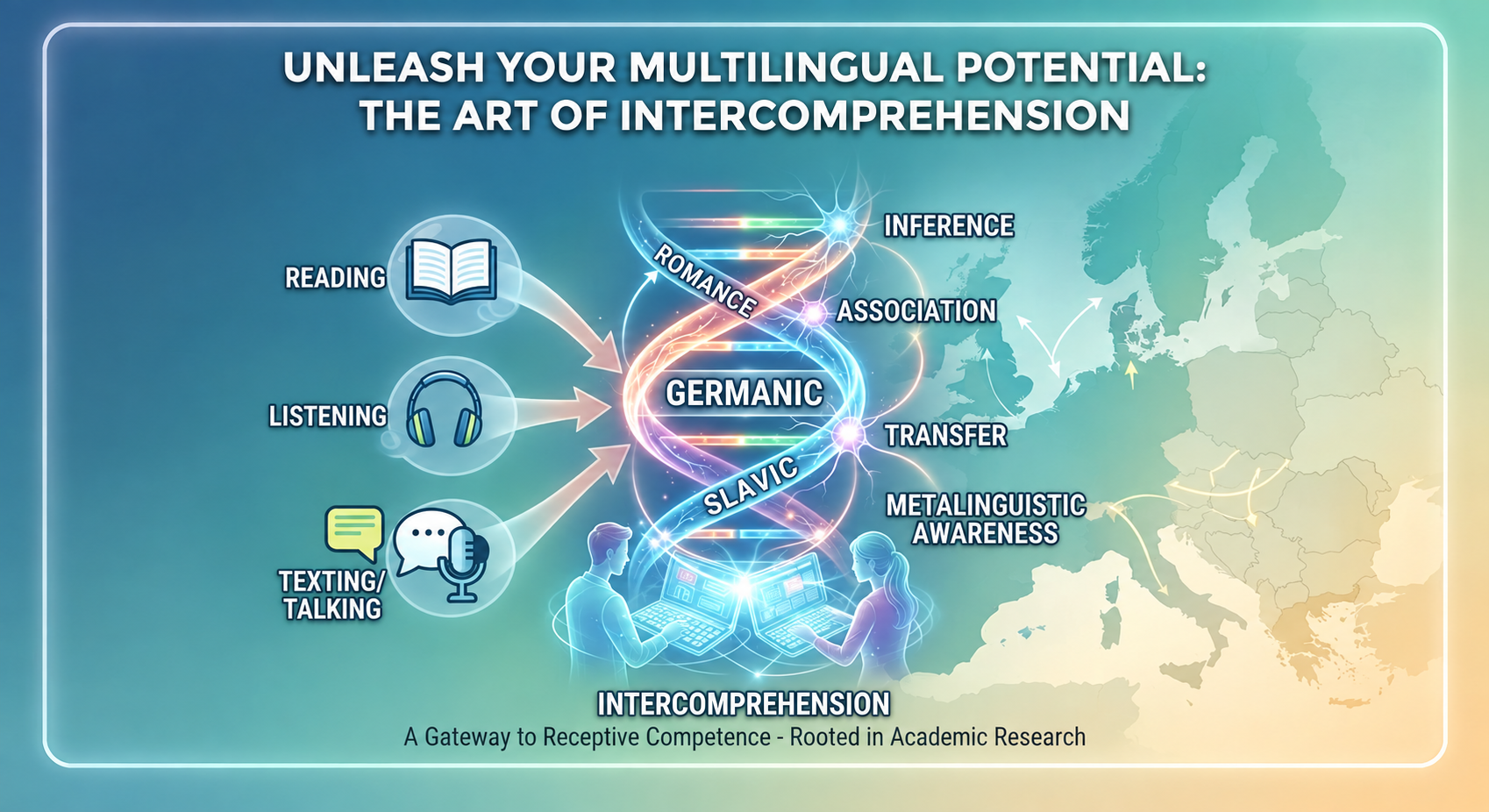
Have you ever glanced at a text in a language you have never formally studied and managed to piece together what it means? If so, you have experienced the foundational concept behind intercomprehension.
For readers who are entirely new to this field, intercomprehension, also known as “mutual intelligibility” between related languages, offers a refreshing, highly efficient alternative to traditional language learning and usage. Instead of spending years striving for active fluency and production in a foreign tongue, intercomprehension focuses on unlocking receptive competence — the ability to extract or comprehend information in an unknown language by drawing upon a related language already present in your multilingual repertoire.
1. What Is Intercomprehension?
Intercomprehension is a form of meaning extraction from a source in an unknown language related to a language you already know. It capitalizes on the genetic kinship and shared structures between related languages and the cognitive processes of human comprehension. While different research groups in the field of intercomprehension offer their own definition, we believe it’s important to introduce the following constrains:
- Receptive Competence: It is a receptive competence that can be activated across various forms, whether reading, listening, texting, or talking. The common communicative strategies as meaning negotiation, gestures, etc. fall outside of the realm of intercomprehension since, precisely, they are common to any form of interlinguistic communication.
- Flexible Starting Points: The base language used to decode the input does not strictly have to be one’s mother tongue, provided it is part of the speaker’s active multilingual repertoire. We consider the debate about the “mother tongue” status obsolete.
- Target Language Status: The language being understood must be previously unknown to the individual. If you’re a native speaker of Catalan from Catalunya, understanding Spanish would by no means be intercomprehension to you.
- Linguistic Proximity: Both the base language and the target language must belong to the same linguistic family. There have been various experiments on crossing the linguistic family borders in intercomprehension, however, there’s solid research showing that in some cases, even between languages of the same group (such as spoken French or any form or Romanian to most speakers of other Romance languages are challenges that are close to impossible) — let alone intercomprehension across the families, let’s be realistic.
Click to view bibliography
Heeringa, W.; Golubovic, J.; Gooskens, C.; Schüppert, A.; Swarte, F.; Voigt, S. (2013): Lexical and orthographic distances between Germanic, Romance and Slavic languages and their relationship to geographic distance. En: C. S. Gooskens y R. van Bezooijen (eds.): Phonetics in Europe. Frankfurt am Main: Peter Lang, pp. 99–137.
López Alonso, C.; Séré, A. (2001): La lectura en lengua extranjera. El caso de las lenguas románicas. Hamburg: Buske (Romanistik in Geschichte und Gegenwart Beiheft, 6).
Schmidely, J.; Alvar Ezquerra, M.; Hernández González, C. (2001): De una a cuatro lenguas. Intercomprensión románica, del español al portugués, al italiano y al francés. Madrid: Arco/Libros.
2. How Intercomprehension Works: Cognition and Language Families
When languages share a common ancestor, speakers can exploit structural similarities by utilizing specific cognitive strategies:
- Analogy, Association, and Transfer: Drawing parallels between familiar words in your known language and the target text.
- Approximation and Inference: Using contextual clues, approximations, and deliberate inferences to bridge gaps in vocabulary.
-
- Metalinguistic Awareness: Recognizing how morphological and syntactic structures mirror one another across sister languages.
A Crucial Note on Language Families
Intercomprehension only operates effectively when languages belong to the same family. Speakers of languages from entirely different families (such as Germanic English and Romance Italian) do not experience mutual intelligibility or spontaneous comprehension. However, we should mention another phenomenon, which is known as “bridge languages”.
For example, English speakers benefit from thousands of shared Greco-Latin etymological roots. This written transparency for technical or formal terms is a huge advantage that allows to approach both Germanic and Romance families when learning a new language, but at the same time make this language less belonging to its family and hence, less intercomprehensible. Same occurs with French.
3. The Four Dimensions of Intercomprehension
Intercomprehension manifests across a continuous matrix defined by two main axes: Interaction vs. Reception and Reading vs. Listening.
Depending on how it is applied, it can involve:
- Reading (reception): Reading books, articles, or websites in a related unknown language. Pure intercomprehension, there’s no one on the other side of your book able to reply to your doubts.
- Listening (reception): Listening to audiobooks, radio broadcasts, or films. Pure intercomprehension, you can’t interact with a movie in case you’ve failed to understand something.
- Written communication (interaction): Exchanging messages via chat or email where each participant reads the other’s language and engaging both in intercomprehension and meaning negotiation (shared strategies).
- Spoken communication (interaction): Engaging in live conversations utilizing both intercomprehension and meaning negotiation strategies.
4. Why Isn’t Intercomprehension a Common Practice?
Given how simple it may seem, you might wonder why the general public doesn’t practice intercomprehension routinely. Why bother to learn a foreign language, if you can, supposedly understand millions of other people that speak languages similar to yours? Academic research highlights three primary barriers holding it back:
- Lack of Awareness: Most European citizens do not realize they can recycle their existing linguistic knowledge to extract direct meaning from a related language.
- Cognitive Cost: Processing an unknown language demands active working memory and mental effort. For pure linguistic economy, people often default to avoidance, translation, or a global lingua franca like English. NOTE: given that IC demands cognitive resources and forces you for apply cognitive strategies of meaning extraction, it’s a brilliant form of brain training.
- The Monolingual Habit: Society operates under a rigid expectation of monolingual discourse, meaning people rarely consider intercomprehension as a practical, everyday tool.
5. The Future: Didactics and Multilingualism
Despite these psychological and cultural hurdles, intercomprehension is quite an exciting field in applied linguistics.
Researchers and educators focus on identifying and systematizing these intuitive cognitive strategies so they can be taught explicitly. By training learners to heighten their metalinguistic awareness, educational programs aim to preserve linguistic diversity, foster deep plurilingualism, and unlock a vast, underutilized potential for intercultural communication. With the latest PISA report, betting on intercomprehension could be a fantastic way of improving reading comprehension skills.
